Arccaptain Accessories
\nNEMA 6-50 Welder Extension Cord —
8AWG & 10AWG, 20ft to 50ft
\nThe extension cord between your panel and your welder is part of the electrical circuit — and it limits how much power actually reaches your machine. An undersized cord introduces resistance, which means voltage drop at the machine end, inconsistent arc performance, nuisance breaker trips, and in sustained use cases, overheating wire insulation. None of those outcomes are about the welder. They're about the cord.
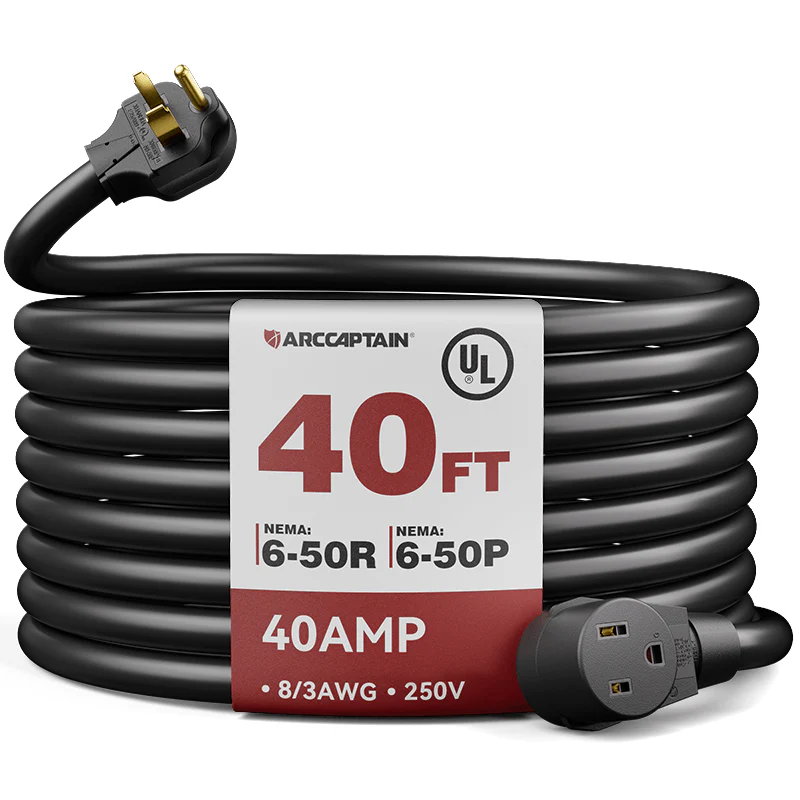
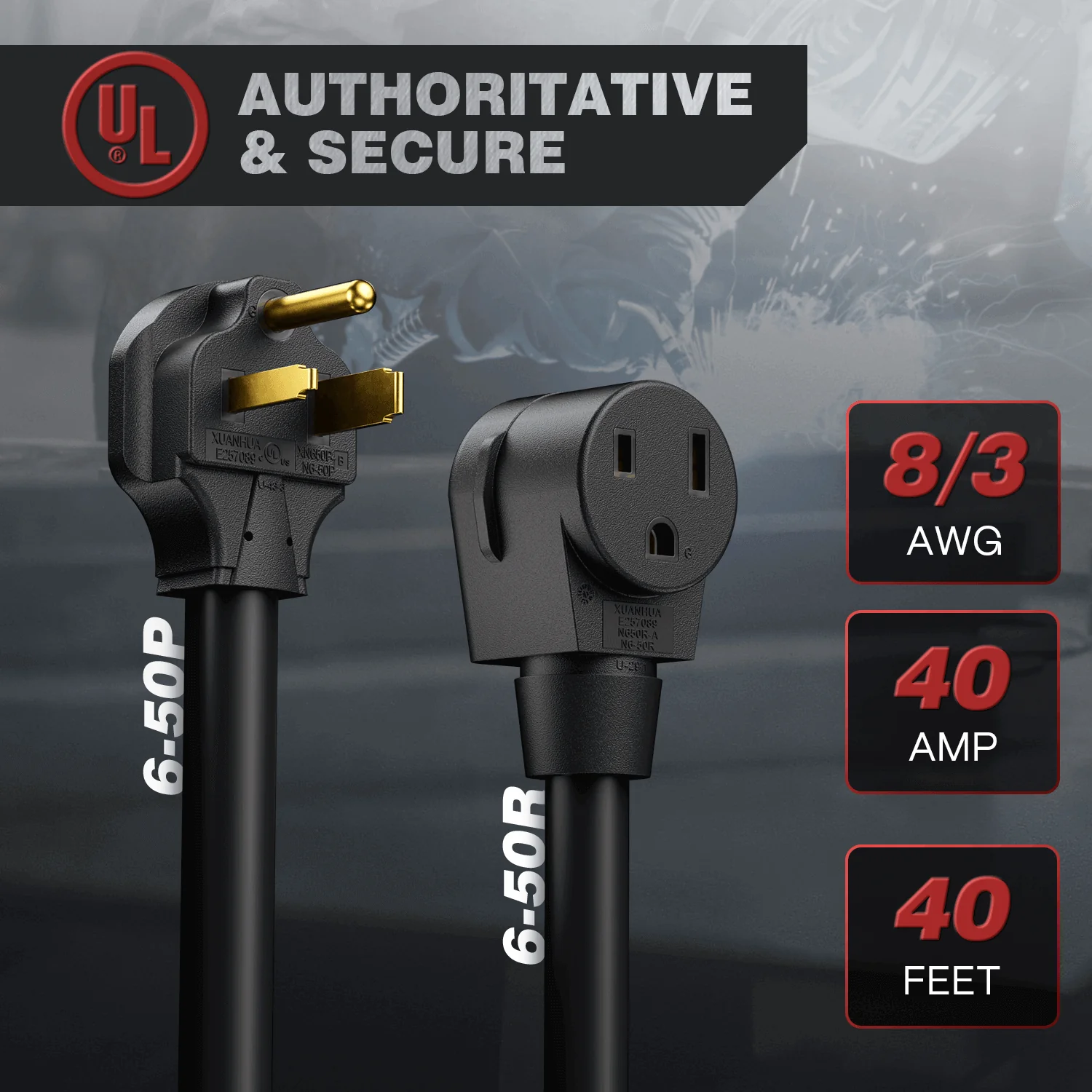
\nThese NEMA 6-50 extension cords come in six configurations across two gauges (8AWG and 10AWG) and three lengths (20ft, 40ft, 50ft) — covering home garage setups through workshop, farm, and job site use at both 110V/120V and 220V/240V. Use the machine compatibility tables below to find the recommended gauge for your specific Arccaptain model and operating voltage.
\nLow-power welders, short-distance home garage use. Minimal voltage drop at this length for compatible machines.
\nOccasional repositioning for home users. Not for high-power or continuous-duty applications at this length.
\nExtended reach for home and light-duty use. Longer run increases voltage drop — only suitable for machines that recommend 10AWG at this voltage.
\nMid- to high-power welders at short distances. Stable, full-rated performance for professional and semi-professional machines.
\nWorkshops, construction sites, and farms with frequent machine movement. Keeps voltage drop within acceptable limits at this length.
\nHigh-power welders requiring maximum reach. The right choice for long-distance runs — delivers stable performance with less voltage drop than 10AWG at the same length.
\nUnderstanding Your Options
\nGauge and Length — Two Variables, One Decision
\nAWG (American Wire Gauge) determines how much current the cord can safely carry. Length determines how much that current capacity matters. Both affect your machine's actual output power — understanding both lets you make the right choice the first time.
\nAWG works in reverse — 8AWG is physically thicker than 10AWG and carries more current safely. The thicker wire has lower resistance, which means less voltage drop and less heat generated under load. Choosing a cord rated below your machine's draw creates resistance in the circuit, which reduces effective output and generates heat in the wire itself.
\nLength — What Each Option Gives You
\nRule of thumb: When in doubt between 8AWG and 10AWG, always choose 8AWG. It is never the wrong choice — it simply provides more current capacity than some machines require. Using 10AWG on a machine that needs 8AWG creates performance and safety issues. Using 8AWG on a machine that only needs 10AWG creates none.
\nAll Six Configurations
\nComplete Comparison — All Variants
\nConfirm your configuration choice with this full-spec comparison of all six available options.
\n| Variant | \nGauge | \nLength | \nRated Current | \nBest For | \n
|---|---|---|---|---|
| 10AWG / 20ft | \n10AWG | \n20ft (6m) | \n30A | \nLow-power welders, short-distance home garage or workshop use | \n
| 10AWG / 40ft | \n10AWG | \n40ft (12m) | \n30A | \nOccasional welder repositioning for home users; not for high-power applications | \n
| 10AWG / 50ft | \n10AWG | \n50ft (15m) | \n30A | \nHome use and light-duty welders needing extended reach; not for high-power machines | \n
| 8AWG / 20ft | \n8AWG | \n20ft (6m) | \n40A | \nMid- to high-power welders at short distances — stable performance for professional machines | \n
| 8AWG / 40ft | \n8AWG | \n40ft (12m) | \n40A | \nWorkshops, construction sites, and farms requiring mobility without sacrificing current capacity | \n
| 8AWG / 50ft | \n8AWG | \n50ft (15m) | \n40A | \nHigh-power welders at maximum reach — stable performance over long distances with minimal voltage drop | \n
Machine Compatibility
\nFind the Right Gauge for Your Arccaptain Machine
\nLook up your machine model and operating voltage below. The recommended gauge is the minimum for that machine and voltage combination. When running at 50ft, if your machine requires 8AWG, use 8AWG at all lengths — the longer the run, the more critical the gauge choice becomes.
\n| Model | \n110V / 120V | \n220V / 240V | \n
|---|---|---|
| CUT50 | \n8 AWG | \n10 AWG | \n
| CUT55 LED | \n8 AWG | \n10 AWG | \n
| CUT55 Pro | \n8 AWG | \n10 AWG | \n
| CUT55 Prolux | \n8 AWG | \n8 AWG | \n
| CUT55 NON-HF | \n8 AWG | \n8 AWG | \n
| CUT55 MP | \n8 AWG | \n8 AWG | \n
| Model | \n110V / 120V | \n220V / 240V | \n
|---|---|---|
| MIG145 Pro | \n8 AWG | \n— | \n
| MIG160 | \n8 AWG | \n10 AWG | \n
| MIG165 | \n8 AWG | \n10 AWG | \n
| MIG165 Pro | \n— | \n10 AWG | \n
| MIG200 | \n8 AWG | \n10 AWG | \n
| MIG200 Fit | \n8 AWG | \n10 AWG | \n
| MIG250 | \n— | \n8 AWG | \n
| MIG205 MP | \n8 AWG | \n8 AWG | \n
| Model | \n110V / 120V | \n220V / 240V | \n
|---|---|---|
| TIG200 | \n8 AWG | \n8 AWG | \n
| TIG200P AC DC | \n8 AWG | \n10 AWG | \n
| TIG205 Pro | \n8 AWG | \n10 AWG | \n
| TIG205P Pro | \n8 AWG | \n10 AWG | \n
| Model | \n110V / 120V | \n220V / 240V | \n
|---|---|---|
| ARC160 | \n10 AWG | \n10 AWG | \n
| ARC200 | \n8 AWG | \n8 AWG | \n
| ARC165 Pro | \n10 AWG | \n10 AWG | \n
| ARC205 Pro | \n8 AWG | \n8 AWG | \n
How to read these tables: Red values (8 AWG) indicate the cord must handle higher current at that voltage — use an 8AWG variant. Black values (10 AWG) indicate current draw is within 10AWG capacity at that voltage. A dash (—) means the machine does not support that input voltage. At 50ft, always use 8AWG if your machine recommends 8AWG at any length — voltage drop increases with run length.
\nWhy It Matters
\nWhat Actually Happens When the Cord Is Wrong
\nAn undersized extension cord doesn't just underperform — it creates problems that are easy to misattribute to the welder itself. Here's what happens in practice.
\nEvery foot of wire has resistance. At 50ft with 10AWG on a 30A machine, the voltage at the welder's input terminal can be 3–8V below the wall outlet voltage — enough to noticeably change arc behavior, reduce duty cycle, and make the machine behave inconsistently even with settings that worked fine on a shorter or heavier cord. This is often mistaken for a welder problem when it's entirely a cord problem.
\nWhen a cord is undersized, its resistance causes the machine to draw additional current to compensate for the voltage drop — which can push total circuit current above the breaker's threshold and trip it during welding. This is a reliable indicator that the cord is the wrong spec. Upgrading to 8AWG eliminates most of these trips.
\nA cord carrying sustained current above its rating generates heat in the wire and — more critically — at the connection points. Heat degrades insulation over time, creating a fire hazard that develops gradually and is often not visible externally. The damage is cumulative and typically discovered when the cord fails at an inopportune moment.
\nThe difference between 40ft and 50ft isn't just 10 more feet of reach. At 10AWG, those 10 feet add roughly 20% more resistance to the circuit on top of what was already there at 40ft. For a machine that performed acceptably with a 10AWG/40ft cord, a 10AWG/50ft cord may push voltage drop past the threshold where arc performance degrades noticeably. If you need 50ft of reach, 8AWG is the correct choice for any machine drawing over 20A.
\nWhich One Should You Buy
\nNarrow It Down Fast
\nCheck your machine in the compatibility tables above, then confirm your final choice here based on your installation distance and usage pattern.
\nChoose 10AWG/20ft for fixed nearby outlet installations. Choose 10AWG/40ft for occasional repositioning in a home shop where the machine's draw is comfortably within 30A. Use 10AWG/50ft only if you need extended reach and your machine specifically recommends 10AWG at your operating voltage — typically lighter machines at 220V/240V.
\nChoose 8AWG/20ft for fixed shop setups with a nearby outlet. Choose 8AWG/40ft for workshops or garages where the machine moves around. Choose 8AWG/50ft for large workshops, farms, construction sites, or any setup where 40ft isn't enough reach and full performance at distance is required.
\nBuy 8AWG. It handles both voltages without any compromise. Using 10AWG at the voltage that requires 8AWG creates performance and safety issues. When cord specs conflict between voltages or use cases, the heavier gauge always wins.
\nBuy 8AWG/40ft. It handles every Arccaptain machine in the lineup at both voltages, provides enough reach for the vast majority of shop and field setups, and is never the wrong choice. The price difference versus 10AWG is minor; the downside of underspeccing the cord is not.
\nNEMA 6-50 outlet check: These cords require a NEMA 6-50 receptacle — the standard 240V, 50A outlet used for welders in North America. This is a two-pole, three-wire outlet rated at 250V/50A. If your shop currently has a NEMA 6-30 (30A) or NEMA 14-50 outlet, the plug will not match. Confirm your outlet type before ordering. A licensed electrician can install a NEMA 6-50 outlet if your main panel has capacity for a dedicated 50A circuit.
\n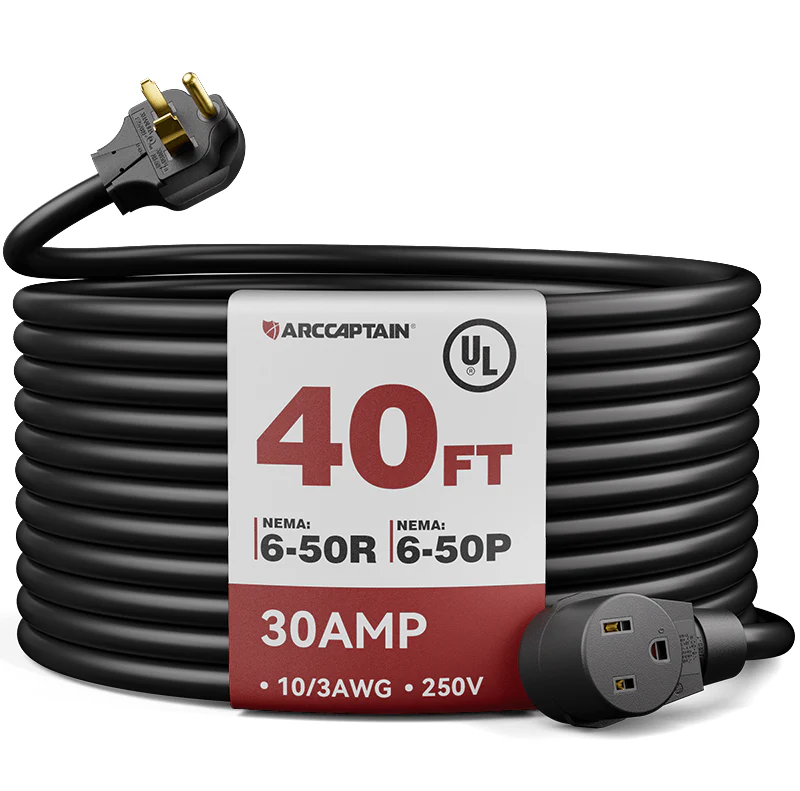
30 Amps 220V Welder Extension Cord for Welding Machines
Arccaptain Accessories
NEMA 6-50 Welder Extension Cord —
8AWG & 10AWG, 20ft to 50ft
The extension cord between your panel and your welder is part of the electrical circuit — and it limits how much power actually reaches your machine. An undersized cord introduces resistance, which means voltage drop at the machine end, inconsistent arc performance, nuisance breaker trips, and in sustained use cases, overheating wire insulation. None of those outcomes are about the welder. They're about the cord.
These NEMA 6-50 extension cords come in six configurations across two gauges (8AWG and 10AWG) and three lengths (20ft, 40ft, 50ft) — covering home garage setups through workshop, farm, and job site use at both 110V/120V and 220V/240V. Use the machine compatibility tables below to find the recommended gauge for your specific Arccaptain model and operating voltage.
Low-power welders, short-distance home garage use. Minimal voltage drop at this length for compatible machines.
Occasional repositioning for home users. Not for high-power or continuous-duty applications at this length.
Extended reach for home and light-duty use. Longer run increases voltage drop — only suitable for machines that recommend 10AWG at this voltage.
Mid- to high-power welders at short distances. Stable, full-rated performance for professional and semi-professional machines.
Workshops, construction sites, and farms with frequent machine movement. Keeps voltage drop within acceptable limits at this length.
High-power welders requiring maximum reach. The right choice for long-distance runs — delivers stable performance with less voltage drop than 10AWG at the same length.
Understanding Your Options
Gauge and Length — Two Variables, One Decision
AWG (American Wire Gauge) determines how much current the cord can safely carry. Length determines how much that current capacity matters. Both affect your machine's actual output power — understanding both lets you make the right choice the first time.
AWG works in reverse — 8AWG is physically thicker than 10AWG and carries more current safely. The thicker wire has lower resistance, which means less voltage drop and less heat generated under load. Choosing a cord rated below your machine's draw creates resistance in the circuit, which reduces effective output and generates heat in the wire itself.
Length — What Each Option Gives You
Rule of thumb: When in doubt between 8AWG and 10AWG, always choose 8AWG. It is never the wrong choice — it simply provides more current capacity than some machines require. Using 10AWG on a machine that needs 8AWG creates performance and safety issues. Using 8AWG on a machine that only needs 10AWG creates none.
All Six Configurations
Complete Comparison — All Variants
Confirm your configuration choice with this full-spec comparison of all six available options.
| Variant | Gauge | Length | Rated Current | Best For |
|---|---|---|---|---|
| 10AWG / 20ft | 10AWG | 20ft (6m) | 30A | Low-power welders, short-distance home garage or workshop use |
| 10AWG / 40ft | 10AWG | 40ft (12m) | 30A | Occasional welder repositioning for home users; not for high-power applications |
| 10AWG / 50ft | 10AWG | 50ft (15m) | 30A | Home use and light-duty welders needing extended reach; not for high-power machines |
| 8AWG / 20ft | 8AWG | 20ft (6m) | 40A | Mid- to high-power welders at short distances — stable performance for professional machines |
| 8AWG / 40ft | 8AWG | 40ft (12m) | 40A | Workshops, construction sites, and farms requiring mobility without sacrificing current capacity |
| 8AWG / 50ft | 8AWG | 50ft (15m) | 40A | High-power welders at maximum reach — stable performance over long distances with minimal voltage drop |
Machine Compatibility
Find the Right Gauge for Your Arccaptain Machine
Look up your machine model and operating voltage below. The recommended gauge is the minimum for that machine and voltage combination. When running at 50ft, if your machine requires 8AWG, use 8AWG at all lengths — the longer the run, the more critical the gauge choice becomes.
| Model | 110V / 120V | 220V / 240V |
|---|---|---|
| CUT50 | 8 AWG | 10 AWG |
| CUT55 LED | 8 AWG | 10 AWG |
| CUT55 Pro | 8 AWG | 10 AWG |
| CUT55 Prolux | 8 AWG | 8 AWG |
| CUT55 NON-HF | 8 AWG | 8 AWG |
| CUT55 MP | 8 AWG | 8 AWG |
| Model | 110V / 120V | 220V / 240V |
|---|---|---|
| MIG145 Pro | 8 AWG | — |
| MIG160 | 8 AWG | 10 AWG |
| MIG165 | 8 AWG | 10 AWG |
| MIG165 Pro | — | 10 AWG |
| MIG200 | 8 AWG | 10 AWG |
| MIG200 Fit | 8 AWG | 10 AWG |
| MIG250 | — | 8 AWG |
| MIG205 MP | 8 AWG | 8 AWG |
| Model | 110V / 120V | 220V / 240V |
|---|---|---|
| TIG200 | 8 AWG | 8 AWG |
| TIG200P AC DC | 8 AWG | 10 AWG |
| TIG205 Pro | 8 AWG | 10 AWG |
| TIG205P Pro | 8 AWG | 10 AWG |
| Model | 110V / 120V | 220V / 240V |
|---|---|---|
| ARC160 | 10 AWG | 10 AWG |
| ARC200 | 8 AWG | 8 AWG |
| ARC165 Pro | 10 AWG | 10 AWG |
| ARC205 Pro | 8 AWG | 8 AWG |
How to read these tables: Red values (8 AWG) indicate the cord must handle higher current at that voltage — use an 8AWG variant. Black values (10 AWG) indicate current draw is within 10AWG capacity at that voltage. A dash (—) means the machine does not support that input voltage. At 50ft, always use 8AWG if your machine recommends 8AWG at any length — voltage drop increases with run length.
Why It Matters
What Actually Happens When the Cord Is Wrong
An undersized extension cord doesn't just underperform — it creates problems that are easy to misattribute to the welder itself. Here's what happens in practice.
Every foot of wire has resistance. At 50ft with 10AWG on a 30A machine, the voltage at the welder's input terminal can be 3–8V below the wall outlet voltage — enough to noticeably change arc behavior, reduce duty cycle, and make the machine behave inconsistently even with settings that worked fine on a shorter or heavier cord. This is often mistaken for a welder problem when it's entirely a cord problem.
When a cord is undersized, its resistance causes the machine to draw additional current to compensate for the voltage drop — which can push total circuit current above the breaker's threshold and trip it during welding. This is a reliable indicator that the cord is the wrong spec. Upgrading to 8AWG eliminates most of these trips.
A cord carrying sustained current above its rating generates heat in the wire and — more critically — at the connection points. Heat degrades insulation over time, creating a fire hazard that develops gradually and is often not visible externally. The damage is cumulative and typically discovered when the cord fails at an inopportune moment.
The difference between 40ft and 50ft isn't just 10 more feet of reach. At 10AWG, those 10 feet add roughly 20% more resistance to the circuit on top of what was already there at 40ft. For a machine that performed acceptably with a 10AWG/40ft cord, a 10AWG/50ft cord may push voltage drop past the threshold where arc performance degrades noticeably. If you need 50ft of reach, 8AWG is the correct choice for any machine drawing over 20A.
Which One Should You Buy
Narrow It Down Fast
Check your machine in the compatibility tables above, then confirm your final choice here based on your installation distance and usage pattern.
Choose 10AWG/20ft for fixed nearby outlet installations. Choose 10AWG/40ft for occasional repositioning in a home shop where the machine's draw is comfortably within 30A. Use 10AWG/50ft only if you need extended reach and your machine specifically recommends 10AWG at your operating voltage — typically lighter machines at 220V/240V.
Choose 8AWG/20ft for fixed shop setups with a nearby outlet. Choose 8AWG/40ft for workshops or garages where the machine moves around. Choose 8AWG/50ft for large workshops, farms, construction sites, or any setup where 40ft isn't enough reach and full performance at distance is required.
Buy 8AWG. It handles both voltages without any compromise. Using 10AWG at the voltage that requires 8AWG creates performance and safety issues. When cord specs conflict between voltages or use cases, the heavier gauge always wins.
Buy 8AWG/40ft. It handles every Arccaptain machine in the lineup at both voltages, provides enough reach for the vast majority of shop and field setups, and is never the wrong choice. The price difference versus 10AWG is minor; the downside of underspeccing the cord is not.
NEMA 6-50 outlet check: These cords require a NEMA 6-50 receptacle — the standard 240V, 50A outlet used for welders in North America. This is a two-pole, three-wire outlet rated at 250V/50A. If your shop currently has a NEMA 6-30 (30A) or NEMA 14-50 outlet, the plug will not match. Confirm your outlet type before ordering. A licensed electrician can install a NEMA 6-50 outlet if your main panel has capacity for a dedicated 50A circuit.
Arccaptain Accessories
NEMA 6-50 Welder Extension Cord —
8AWG & 10AWG, 20ft to 50ft
The extension cord between your panel and your welder is part of the electrical circuit — and it limits how much power actually reaches your machine. An undersized cord introduces resistance, which means voltage drop at the machine end, inconsistent arc performance, nuisance breaker trips, and in sustained use cases, overheating wire insulation. None of those outcomes are about the welder. They're about the cord.
These NEMA 6-50 extension cords come in six configurations across two gauges (8AWG and 10AWG) and three lengths (20ft, 40ft, 50ft) — covering home garage setups through workshop, farm, and job site use at both 110V/120V and 220V/240V. Use the machine compatibility tables below to find the recommended gauge for your specific Arccaptain model and operating voltage.
Low-power welders, short-distance home garage use. Minimal voltage drop at this length for compatible machines.
Occasional repositioning for home users. Not for high-power or continuous-duty applications at this length.
Extended reach for home and light-duty use. Longer run increases voltage drop — only suitable for machines that recommend 10AWG at this voltage.
Mid- to high-power welders at short distances. Stable, full-rated performance for professional and semi-professional machines.
Workshops, construction sites, and farms with frequent machine movement. Keeps voltage drop within acceptable limits at this length.
High-power welders requiring maximum reach. The right choice for long-distance runs — delivers stable performance with less voltage drop than 10AWG at the same length.
Understanding Your Options
Gauge and Length — Two Variables, One Decision
AWG (American Wire Gauge) determines how much current the cord can safely carry. Length determines how much that current capacity matters. Both affect your machine's actual output power — understanding both lets you make the right choice the first time.
AWG works in reverse — 8AWG is physically thicker than 10AWG and carries more current safely. The thicker wire has lower resistance, which means less voltage drop and less heat generated under load. Choosing a cord rated below your machine's draw creates resistance in the circuit, which reduces effective output and generates heat in the wire itself.
Length — What Each Option Gives You
Rule of thumb: When in doubt between 8AWG and 10AWG, always choose 8AWG. It is never the wrong choice — it simply provides more current capacity than some machines require. Using 10AWG on a machine that needs 8AWG creates performance and safety issues. Using 8AWG on a machine that only needs 10AWG creates none.
All Six Configurations
Complete Comparison — All Variants
Confirm your configuration choice with this full-spec comparison of all six available options.
| Variant | Gauge | Length | Rated Current | Best For |
|---|---|---|---|---|
| 10AWG / 20ft | 10AWG | 20ft (6m) | 30A | Low-power welders, short-distance home garage or workshop use |
| 10AWG / 40ft | 10AWG | 40ft (12m) | 30A | Occasional welder repositioning for home users; not for high-power applications |
| 10AWG / 50ft | 10AWG | 50ft (15m) | 30A | Home use and light-duty welders needing extended reach; not for high-power machines |
| 8AWG / 20ft | 8AWG | 20ft (6m) | 40A | Mid- to high-power welders at short distances — stable performance for professional machines |
| 8AWG / 40ft | 8AWG | 40ft (12m) | 40A | Workshops, construction sites, and farms requiring mobility without sacrificing current capacity |
| 8AWG / 50ft | 8AWG | 50ft (15m) | 40A | High-power welders at maximum reach — stable performance over long distances with minimal voltage drop |
Machine Compatibility
Find the Right Gauge for Your Arccaptain Machine
Look up your machine model and operating voltage below. The recommended gauge is the minimum for that machine and voltage combination. When running at 50ft, if your machine requires 8AWG, use 8AWG at all lengths — the longer the run, the more critical the gauge choice becomes.
| Model | 110V / 120V | 220V / 240V |
|---|---|---|
| CUT50 | 8 AWG | 10 AWG |
| CUT55 LED | 8 AWG | 10 AWG |
| CUT55 Pro | 8 AWG | 10 AWG |
| CUT55 Prolux | 8 AWG | 8 AWG |
| CUT55 NON-HF | 8 AWG | 8 AWG |
| CUT55 MP | 8 AWG | 8 AWG |
| Model | 110V / 120V | 220V / 240V |
|---|---|---|
| MIG145 Pro | 8 AWG | — |
| MIG160 | 8 AWG | 10 AWG |
| MIG165 | 8 AWG | 10 AWG |
| MIG165 Pro | — | 10 AWG |
| MIG200 | 8 AWG | 10 AWG |
| MIG200 Fit | 8 AWG | 10 AWG |
| MIG250 | — | 8 AWG |
| MIG205 MP | 8 AWG | 8 AWG |
| Model | 110V / 120V | 220V / 240V |
|---|---|---|
| TIG200 | 8 AWG | 8 AWG |
| TIG200P AC DC | 8 AWG | 10 AWG |
| TIG205 Pro | 8 AWG | 10 AWG |
| TIG205P Pro | 8 AWG | 10 AWG |
| Model | 110V / 120V | 220V / 240V |
|---|---|---|
| ARC160 | 10 AWG | 10 AWG |
| ARC200 | 8 AWG | 8 AWG |
| ARC165 Pro | 10 AWG | 10 AWG |
| ARC205 Pro | 8 AWG | 8 AWG |
How to read these tables: Red values (8 AWG) indicate the cord must handle higher current at that voltage — use an 8AWG variant. Black values (10 AWG) indicate current draw is within 10AWG capacity at that voltage. A dash (—) means the machine does not support that input voltage. At 50ft, always use 8AWG if your machine recommends 8AWG at any length — voltage drop increases with run length.
Why It Matters
What Actually Happens When the Cord Is Wrong
An undersized extension cord doesn't just underperform — it creates problems that are easy to misattribute to the welder itself. Here's what happens in practice.
Every foot of wire has resistance. At 50ft with 10AWG on a 30A machine, the voltage at the welder's input terminal can be 3–8V below the wall outlet voltage — enough to noticeably change arc behavior, reduce duty cycle, and make the machine behave inconsistently even with settings that worked fine on a shorter or heavier cord. This is often mistaken for a welder problem when it's entirely a cord problem.
When a cord is undersized, its resistance causes the machine to draw additional current to compensate for the voltage drop — which can push total circuit current above the breaker's threshold and trip it during welding. This is a reliable indicator that the cord is the wrong spec. Upgrading to 8AWG eliminates most of these trips.
A cord carrying sustained current above its rating generates heat in the wire and — more critically — at the connection points. Heat degrades insulation over time, creating a fire hazard that develops gradually and is often not visible externally. The damage is cumulative and typically discovered when the cord fails at an inopportune moment.
The difference between 40ft and 50ft isn't just 10 more feet of reach. At 10AWG, those 10 feet add roughly 20% more resistance to the circuit on top of what was already there at 40ft. For a machine that performed acceptably with a 10AWG/40ft cord, a 10AWG/50ft cord may push voltage drop past the threshold where arc performance degrades noticeably. If you need 50ft of reach, 8AWG is the correct choice for any machine drawing over 20A.
Which One Should You Buy
Narrow It Down Fast
Check your machine in the compatibility tables above, then confirm your final choice here based on your installation distance and usage pattern.
Choose 10AWG/20ft for fixed nearby outlet installations. Choose 10AWG/40ft for occasional repositioning in a home shop where the machine's draw is comfortably within 30A. Use 10AWG/50ft only if you need extended reach and your machine specifically recommends 10AWG at your operating voltage — typically lighter machines at 220V/240V.
Choose 8AWG/20ft for fixed shop setups with a nearby outlet. Choose 8AWG/40ft for workshops or garages where the machine moves around. Choose 8AWG/50ft for large workshops, farms, construction sites, or any setup where 40ft isn't enough reach and full performance at distance is required.
Buy 8AWG. It handles both voltages without any compromise. Using 10AWG at the voltage that requires 8AWG creates performance and safety issues. When cord specs conflict between voltages or use cases, the heavier gauge always wins.
Buy 8AWG/40ft. It handles every Arccaptain machine in the lineup at both voltages, provides enough reach for the vast majority of shop and field setups, and is never the wrong choice. The price difference versus 10AWG is minor; the downside of underspeccing the cord is not.
NEMA 6-50 outlet check: These cords require a NEMA 6-50 receptacle — the standard 240V, 50A outlet used for welders in North America. This is a two-pole, three-wire outlet rated at 250V/50A. If your shop currently has a NEMA 6-30 (30A) or NEMA 14-50 outlet, the plug will not match. Confirm your outlet type before ordering. A licensed electrician can install a NEMA 6-50 outlet if your main panel has capacity for a dedicated 50A circuit.
Original: $59.99
-65%$59.99
$21.00Description
Arccaptain Accessories
NEMA 6-50 Welder Extension Cord —
8AWG & 10AWG, 20ft to 50ft
The extension cord between your panel and your welder is part of the electrical circuit — and it limits how much power actually reaches your machine. An undersized cord introduces resistance, which means voltage drop at the machine end, inconsistent arc performance, nuisance breaker trips, and in sustained use cases, overheating wire insulation. None of those outcomes are about the welder. They're about the cord.
These NEMA 6-50 extension cords come in six configurations across two gauges (8AWG and 10AWG) and three lengths (20ft, 40ft, 50ft) — covering home garage setups through workshop, farm, and job site use at both 110V/120V and 220V/240V. Use the machine compatibility tables below to find the recommended gauge for your specific Arccaptain model and operating voltage.
Low-power welders, short-distance home garage use. Minimal voltage drop at this length for compatible machines.
Occasional repositioning for home users. Not for high-power or continuous-duty applications at this length.
Extended reach for home and light-duty use. Longer run increases voltage drop — only suitable for machines that recommend 10AWG at this voltage.
Mid- to high-power welders at short distances. Stable, full-rated performance for professional and semi-professional machines.
Workshops, construction sites, and farms with frequent machine movement. Keeps voltage drop within acceptable limits at this length.
High-power welders requiring maximum reach. The right choice for long-distance runs — delivers stable performance with less voltage drop than 10AWG at the same length.
Understanding Your Options
Gauge and Length — Two Variables, One Decision
AWG (American Wire Gauge) determines how much current the cord can safely carry. Length determines how much that current capacity matters. Both affect your machine's actual output power — understanding both lets you make the right choice the first time.
AWG works in reverse — 8AWG is physically thicker than 10AWG and carries more current safely. The thicker wire has lower resistance, which means less voltage drop and less heat generated under load. Choosing a cord rated below your machine's draw creates resistance in the circuit, which reduces effective output and generates heat in the wire itself.
Length — What Each Option Gives You
Rule of thumb: When in doubt between 8AWG and 10AWG, always choose 8AWG. It is never the wrong choice — it simply provides more current capacity than some machines require. Using 10AWG on a machine that needs 8AWG creates performance and safety issues. Using 8AWG on a machine that only needs 10AWG creates none.
All Six Configurations
Complete Comparison — All Variants
Confirm your configuration choice with this full-spec comparison of all six available options.
| Variant | Gauge | Length | Rated Current | Best For |
|---|---|---|---|---|
| 10AWG / 20ft | 10AWG | 20ft (6m) | 30A | Low-power welders, short-distance home garage or workshop use |
| 10AWG / 40ft | 10AWG | 40ft (12m) | 30A | Occasional welder repositioning for home users; not for high-power applications |
| 10AWG / 50ft | 10AWG | 50ft (15m) | 30A | Home use and light-duty welders needing extended reach; not for high-power machines |
| 8AWG / 20ft | 8AWG | 20ft (6m) | 40A | Mid- to high-power welders at short distances — stable performance for professional machines |
| 8AWG / 40ft | 8AWG | 40ft (12m) | 40A | Workshops, construction sites, and farms requiring mobility without sacrificing current capacity |
| 8AWG / 50ft | 8AWG | 50ft (15m) | 40A | High-power welders at maximum reach — stable performance over long distances with minimal voltage drop |
Machine Compatibility
Find the Right Gauge for Your Arccaptain Machine
Look up your machine model and operating voltage below. The recommended gauge is the minimum for that machine and voltage combination. When running at 50ft, if your machine requires 8AWG, use 8AWG at all lengths — the longer the run, the more critical the gauge choice becomes.
| Model | 110V / 120V | 220V / 240V |
|---|---|---|
| CUT50 | 8 AWG | 10 AWG |
| CUT55 LED | 8 AWG | 10 AWG |
| CUT55 Pro | 8 AWG | 10 AWG |
| CUT55 Prolux | 8 AWG | 8 AWG |
| CUT55 NON-HF | 8 AWG | 8 AWG |
| CUT55 MP | 8 AWG | 8 AWG |
| Model | 110V / 120V | 220V / 240V |
|---|---|---|
| MIG145 Pro | 8 AWG | — |
| MIG160 | 8 AWG | 10 AWG |
| MIG165 | 8 AWG | 10 AWG |
| MIG165 Pro | — | 10 AWG |
| MIG200 | 8 AWG | 10 AWG |
| MIG200 Fit | 8 AWG | 10 AWG |
| MIG250 | — | 8 AWG |
| MIG205 MP | 8 AWG | 8 AWG |
| Model | 110V / 120V | 220V / 240V |
|---|---|---|
| TIG200 | 8 AWG | 8 AWG |
| TIG200P AC DC | 8 AWG | 10 AWG |
| TIG205 Pro | 8 AWG | 10 AWG |
| TIG205P Pro | 8 AWG | 10 AWG |
| Model | 110V / 120V | 220V / 240V |
|---|---|---|
| ARC160 | 10 AWG | 10 AWG |
| ARC200 | 8 AWG | 8 AWG |
| ARC165 Pro | 10 AWG | 10 AWG |
| ARC205 Pro | 8 AWG | 8 AWG |
How to read these tables: Red values (8 AWG) indicate the cord must handle higher current at that voltage — use an 8AWG variant. Black values (10 AWG) indicate current draw is within 10AWG capacity at that voltage. A dash (—) means the machine does not support that input voltage. At 50ft, always use 8AWG if your machine recommends 8AWG at any length — voltage drop increases with run length.
Why It Matters
What Actually Happens When the Cord Is Wrong
An undersized extension cord doesn't just underperform — it creates problems that are easy to misattribute to the welder itself. Here's what happens in practice.
Every foot of wire has resistance. At 50ft with 10AWG on a 30A machine, the voltage at the welder's input terminal can be 3–8V below the wall outlet voltage — enough to noticeably change arc behavior, reduce duty cycle, and make the machine behave inconsistently even with settings that worked fine on a shorter or heavier cord. This is often mistaken for a welder problem when it's entirely a cord problem.
When a cord is undersized, its resistance causes the machine to draw additional current to compensate for the voltage drop — which can push total circuit current above the breaker's threshold and trip it during welding. This is a reliable indicator that the cord is the wrong spec. Upgrading to 8AWG eliminates most of these trips.
A cord carrying sustained current above its rating generates heat in the wire and — more critically — at the connection points. Heat degrades insulation over time, creating a fire hazard that develops gradually and is often not visible externally. The damage is cumulative and typically discovered when the cord fails at an inopportune moment.
The difference between 40ft and 50ft isn't just 10 more feet of reach. At 10AWG, those 10 feet add roughly 20% more resistance to the circuit on top of what was already there at 40ft. For a machine that performed acceptably with a 10AWG/40ft cord, a 10AWG/50ft cord may push voltage drop past the threshold where arc performance degrades noticeably. If you need 50ft of reach, 8AWG is the correct choice for any machine drawing over 20A.
Which One Should You Buy
Narrow It Down Fast
Check your machine in the compatibility tables above, then confirm your final choice here based on your installation distance and usage pattern.
Choose 10AWG/20ft for fixed nearby outlet installations. Choose 10AWG/40ft for occasional repositioning in a home shop where the machine's draw is comfortably within 30A. Use 10AWG/50ft only if you need extended reach and your machine specifically recommends 10AWG at your operating voltage — typically lighter machines at 220V/240V.
Choose 8AWG/20ft for fixed shop setups with a nearby outlet. Choose 8AWG/40ft for workshops or garages where the machine moves around. Choose 8AWG/50ft for large workshops, farms, construction sites, or any setup where 40ft isn't enough reach and full performance at distance is required.
Buy 8AWG. It handles both voltages without any compromise. Using 10AWG at the voltage that requires 8AWG creates performance and safety issues. When cord specs conflict between voltages or use cases, the heavier gauge always wins.
Buy 8AWG/40ft. It handles every Arccaptain machine in the lineup at both voltages, provides enough reach for the vast majority of shop and field setups, and is never the wrong choice. The price difference versus 10AWG is minor; the downside of underspeccing the cord is not.
NEMA 6-50 outlet check: These cords require a NEMA 6-50 receptacle — the standard 240V, 50A outlet used for welders in North America. This is a two-pole, three-wire outlet rated at 250V/50A. If your shop currently has a NEMA 6-30 (30A) or NEMA 14-50 outlet, the plug will not match. Confirm your outlet type before ordering. A licensed electrician can install a NEMA 6-50 outlet if your main panel has capacity for a dedicated 50A circuit.